

Betiator is a crash-style betting game that runs inside a live football match, developed by betting-platform provider Delasport. Instead of a random number ticking a multiplier upward, the round is tied to something actually happening on the pitch.
You stake an amount, then pick your trigger: corners or goals. The multiplier climbs until that event happens, and you can cash out any time before it does, except during a dangerous attack or penalty, when cash-out is switched off. Staying in longer can also unlock a bonus boost, extra percentage points on the multiplier, though the round can just as easily end in the first seconds if the trigger lands early. Betiator runs through Delasport-powered sportsbook operators and covers Simulated Reality League (SRL) matches too, so a round is always available.
Quick Facts
| Attribute | Detail |
|---|---|
| Provider | Delasport |
| Available via | Sportsbook operators on the Delasport platform (see "Where to Play Betiator") |
| Trigger options | Corners or goals, chosen by the player before the round starts |
| Cash-out | Available any time before the trigger event lands |
| Cash-out blocked during | Dangerous attacks and penalties |
| Markets | Live football matches, including Simulated Reality League (SRL) |
| Bonus mechanic | Bonus boosts: extra percentage points for surviving without a cash-out |
| Comparable game | Crash-style betting, adapted from the Aviator format to run on real match events |
On This Page
- What Is Betiator?
- How Betiator Works: Step by Step
- Corners or Goals: Choosing Your Trigger
- When Cash-Out Gets Blocked: Danger and Safe Windows
- Betiator Bonus: The Built-In Boost and What Operators Add
- Real Multiplier Example: A Live Round Walkthrough
- Betiator vs Aviator: Key Differences
- Betiator vs Traditional Live Betting
- Simulated Reality League: Betting Around the Clock
- Where to Play Betiator
- How to Find Betiator: A 5-Step Walkthrough
- Cash-Out Strategy: Corner vs Goal Risk Profiles
- Is Betiator Legit? Licensing and Fairness
- Mobile and Live Match Availability
- Frequently Asked Questions
What Is Betiator?
Betiator is a crash-style betting game that sits inside the live match viewer instead of running as a separate app or a stand-alone slot. Delasport, the company behind it, builds the game directly into the same page where you're already watching a match, so there's nothing extra to open and nothing to leave in order to play a round.
The core loop is familiar if you've played any crash game before: place a stake, watch a multiplier climb, decide when to lock in your win before it's too late. What Betiator changes is what "too late" actually means. In most crash games, a random number generator decides when the round ends, and that number has no connection to anything happening in the real world. In Betiator, the round ends when something happens in the match you're watching, a corner or a goal, depending on which one you picked as your trigger. There's no hidden random draw setting the crash point behind the scenes; the football decides.
Delasport teased Betiator without details in December 2025, then gave it a full public debut at ICE Barcelona on January 19, 2026, calling it the first crash-style game built directly into live sports betting rather than sitting next to it as a separate product. Goals was the only trigger at launch. Corners came later, added as a second option and confirmed in place by mid-2026. That framing shapes how it behaves day to day. Because a round needs a live match with a scoreboard, referee decisions, and stoppage time attached to it, Betiator only runs on fixtures currently in progress, real or simulated. You can't open a round on a match that hasn't kicked off, and a round ends the moment the trigger event happens, not on a countdown you set yourself.
That difference is also the main reason bettors who already follow live football tend to gravitate toward it: the outcome you're timing is one you'd be watching anyway, not an abstraction running in a separate window. Worth saying plainly here, since it applies to the whole game: because the trigger is a real match event, it can land at any point, including within seconds of placing your stake. There's no minimum round length built into the mechanic.
How Betiator Works: Step by Step
Betiator runs a fixed six-step round every time: stake, pick a trigger, watch the multiplier climb, cash out (or don't), and see whether the match beat you to it. The sequence is straightforward to describe, but a couple of the steps aren't obvious from watching a single round, so it's worth walking through in order.
-
Pick your match and place your stake. Betiator only opens on a match currently in progress, real or simulated. You choose your stake amount, either from preset chips (5, 10, 25, 50) or a custom stepper, and confirm it with the "Place Bet" button.
Betiator's bet screen with a €15 stake and the quick amount buttons (50, 100, 150, 200) lined up before the Place Bet button See it at the sportsbook -
Choose your trigger. Two tabs sit above the multiplier: Corners and Goals. Whichever one you pick decides what ends your round. This choice is the single biggest lever you have over how the round plays out, and it's covered in more detail in the next section.
Betiator's widget showing the pitch, the Attack indicator, and the Corners and Goals tabs above the bet field See it at the sportsbook -
The multiplier starts climbing. Once your stake is placed, the number ticks upward continuously for as long as the chosen event, corner or goal, hasn't happened in the match.
-
Cash out whenever you want, as long as the window is open. The stake button turns into a cash-out button showing your current potential payout in real time. Tap it and you lock in that multiplier as your win.
-
Watch for the danger window. During a dangerous attack or a penalty, cash-out gets switched off automatically until the match calms back down. This is the part every other crash game skips, and it gets its own section below because it changes how you should actually approach a round.
-
The round ends one of two ways. Either you cash out before the trigger event, and the multiplier at that moment becomes your payout, or the corner or goal happens first and the stake is gone. There's no partial outcome and no do-over mid-round. The interface also has a separate "cancelled" status for a voided bet, distinct from a straightforward win or loss.
What separates this from a typical crash game is step 5. Most crash titles run on a clock and a random draw, with no state in between "still climbing" and "crashed." Betiator adds a third state, a window where the round is technically still live but you can't act on it, because the underlying event (a corner, a penalty, a dangerous spell of pressure) is unfolding in real time. It's a small mechanical addition, but it changes the rhythm of watching a round considerably: you're not just tracking a number, you're reading the match, and the event that ends your round can arrive at any point in that sequence, including almost immediately after you stake.
Corners or Goals: Choosing Your Trigger
Corners and goals aren't just two settings, they're two different bets with genuinely different risk profiles, and Betiator makes you choose one before the round even starts.
Corner betting on Betiator means the round ends the next time a corner is awarded, on either side of the pitch. Corners come around often in a typical match: a team pressing forward, a deflected clearance, a keeper punching a cross out for a corner, all of it counts. That frequency is exactly why corner-trigger rounds tend to be short. You're not committing to a long wait, but you're also not getting much room to build a multiplier before the round is likely to end, and in a match with a lot of early pressure, a corner-trigger round can end within the first exchanges of play.
Next goal betting flips that. Goals are rare relative to corners; most matches produce two or three across ninety minutes, sometimes none for long stretches. Picking Goals as your trigger means your round can run far longer before anything forces a resolution, which is exactly what lets the multiplier climb higher if you're willing to sit through it. It also means longer exposure to the parts of the match where cash-out gets blocked (more on that next), since a team pushing hard for a goal usually means a dangerous attack is close behind.
Neither choice is objectively better; they suit different approaches to watching a match. If you'd rather see a round resolve quickly and don't mind cashing out at a modest multiplier, corners give you that. If you're comfortable watching a match for longer stretches and want more room for the multiplier to grow, accepting that a longer wait also means the danger window comes up more often, goals are the trigger built for that.
One thing worth knowing before you commit: you pick your trigger when you place the stake, and that choice holds for the whole round. If the match swings toward end-to-end football with corners flying in on both ends, that's the environment your goal-trigger round is now playing out in, for better or worse. Reading the shape of the match before you choose, whether it's a game with a team camped in the final third or an even contest with the ball going end to end, tells you more about what to expect than any fixed rule would. Either way, the event you're betting against can happen at any moment once the round is live, and there's no way to pause it to think it over.
The match used in the multiplier walkthrough earlier in this guide makes the point concretely, and it does so with a live example rather than a hypothetical. By the time that round was tracked, the corner count in that fixture stood at 1-11, one side had barely won a corner while the other had picked up eleven, while the goal count sat at 1-1 and hadn't moved in a while. At the very checkpoint recorded at 39:38, the match display briefly showed "Ecke", a corner had just been awarded. On a Corners-trigger round, that's the exact instant the round ends. This particular stake was set to Goals, so the corner passed by without consequence and the multiplier kept climbing straight through it. Same match, same second, two completely different outcomes, depending only on which tab was open when the stake went down.
That's the practical habit worth building before choosing a trigger: check the running corner count and recent goal activity for the match you're on, not just the scoreline. A side that's already won several corners and keeps pressing suggests a Corners round is likely to resolve fast. A match that's gone quiet since the last goal, few clear chances, midfield play, suggests a Goals round has room to run, at least until the pattern changes.
Corners and Goals sit as two tabs on the same live screen, the one that showed a corner at 39:38 while a Goals stake climbed straight through it. To the sportsbook
When Cash-Out Gets Blocked: Danger and Safe Windows
Cash out betting on Betiator isn't available every second the round is live. During a dangerous attack or a penalty, the cash-out button is switched off until the match settles back down, and this single mechanic is what separates Betiator from every other crash game on the market.
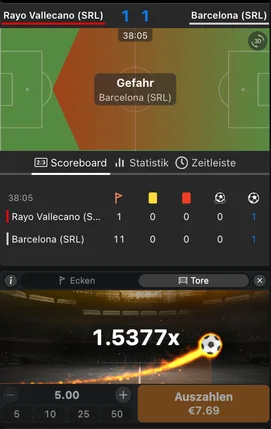
The interface makes the state obvious rather than hiding it. When the match enters a dangerous spell, the round shows a "Gefahr" label (German for danger), the play area turns orange, and the cash-out button goes dark, unpressable no matter how badly you want to take your multiplier off the table. Once the danger has passed, the label switches to "Sicher" (safe), the color goes back to green, and cash-out becomes available again. Those two labels are what the screenshots used throughout this guide show, taken from a German-language build. Delasport's own English promo material confirms the English name for that state: "Danger," shown the same two-line way, the word on top and a team name underneath. The English name for the calm "Sicher" state hasn't turned up on any confirmed material yet, so treat "Danger" as a confirmed label and "Safe" as a working stand-in for whatever the calm state is actually called on an English build.
There's also a separate state worth knowing about. Delasport's promo footage shows a distinct "Attack" label, orange highlight, a team name underneath, on the opposite side of the pitch from where "Danger" showed up in the same material. So the widget isn't just toggling between two states. It's tracking more granularity than the orange/green split covered so far, calm, then building pressure, then outright danger, by the look of it. What isn't confirmed is whether cash-out gets blocked during "Attack" the way it does during "Danger", the footage that shows "Attack" happens before a bet is even placed, so there's no cash-out button on screen to check. Worth separating this from the phrase "dangerous attack" used elsewhere in this guide to describe what triggers a Gefahr/Danger window, that's descriptive wording, not a quote of the on-screen "Attack" label, and the two aren't confirmed to point at the same underlying trigger. Take all of it as an open question, not an assumption in either direction.
Why build a game around a window you can't act in? Without it, cash out betting here would be trivially exploitable the moment a team wins a corner or the referee points to the spot. Anyone watching the broadcast could cash out in the half-second before the trigger event registers, turning the game into a race against stream delay rather than a bet on the match. Locking cash-out during exactly those moments removes that loophole. It also does something else worth noticing: it turns the tensest passages of a match, a corner about to be swung in, a penalty about to be taken, into moments you have to sit through rather than moments you can dodge.
Practically, this changes how a round feels compared to other crash formats. In a standard crash game, you can hit cash out at literally any instant right up until the crash. In Betiator, the safest window to act is when the match is calm, not necessarily when your multiplier looks best. That means a meaningful part of strategy is less about the number on screen and more about reading the state of play: is the ball in a dangerous area right now, or is it not?
One consequence worth flagging plainly: because danger windows cluster around exactly the moments a goal or corner is most likely, a team piling players forward, a set piece about to be delivered, the event that ends your round can land during a stretch where you had no way to cash out even if you wanted to. That's not a bug in the game, it's the mechanic. Go in knowing cash-out isn't guaranteed to be there the instant you want it, and that the round can end without warning at any stage, danger window or not.
There isn't much to do in the window itself beyond waiting it out; the button is unpressable, not slow, so there's no benefit to repeatedly tapping it hoping it reopens a second early. It's also worth going in expecting the window to last: in the round tracked in the multiplier walkthrough earlier in this guide, cash-out stayed blocked across four consecutive checkpoints spanning well over ninety seconds, not a one- or two-second flicker, and the multiplier kept climbing on the same clock the entire time it was locked. What the window does change is when it's worth acting. Because the multiplier doesn't pause just because cash-out does, a danger window that passes without your trigger event landing means cash-out reopens on a higher number than when Gefahr started, that's the block working in your favor. The version working against you is the one already covered above: the event can land inside the window itself, and there's nothing to do about that but accept it going in.
Given both sides of that, the practical read is to treat rising pressure as an early signal, not a late one. If the match is building toward a corner or a set piece and cash-out is still showing green, that's the moment to decide whether to act, before Gefahr appears and takes the choice away. Waiting for the multiplier to look a little better once the danger is already visible on screen is the version of this game that costs people the most, because by then the button may already be gone.
Betiator Bonus: The Built-In Boost and What Operators Add
Bonus boosts are Betiator's reward for patience: the longer your stake survives without the corner or goal you're betting against happening, the further the boost counter shown in Delasport's own demo can climb, and each step adds extra percentage points on top of your current multiplier.
The mechanic sits quietly in the background of every round. You don't request a boost or activate anything, survival time is what moves the counter along. A short corner-trigger round that ends in the first minute effectively never gets there. A longer goal-trigger round that survives several danger windows and keeps climbing gives that counter more time to work through its steps.
Delasport's own promo material gives a glimpse of what a boost looks like on screen: a small counter that climbs in steps, +5%, +10%, +15%, with a countdown timer ticking down to the next step. That's useful for picturing the mechanic, but it's not a menu of guaranteed numbers. Betiator is built as a configurable product, the vendor's own marketing describes it as an add-on with adjustable margins and limits set by whichever operator runs it, and the vendor's own materials already show different stake chip sets than the one live integration confirmed in this guide, which is a sign the numbers are meant to be tuned per operator, not hard-coded. The +5/+10/+15% counter is what Delasport's demo shows, not a fixed payout table guaranteed to apply everywhere Betiator runs. What Betiator doesn't publish anywhere, demo included, is the rule for how a step gets earned, how much survival time or how many near-misses it takes to bump the counter up. That part stays a black box, so treat bonus boosts as a possible upside to staying in longer, not as a number you can plan around or bank on. If a boost does land, it shows up directly in the multiplier the next time you check the cash-out button; there's no separate screen or notification to track down.
Worth separating out plainly, since "bonus" gets used loosely around this game: Betiator itself doesn't carry a standing bonus, no separate welcome offer or deposit match attached to the game specifically. The boost counter above is the only reward mechanic built into Betiator itself. Operators sometimes run their own promotions around live betting or crash-style games more broadly, and those come and go on their own schedule, changing without notice here, so whatever's currently live is worth checking directly on the operator's own promotions page rather than assumed from anything written in this guide.
The practical takeaway is simple: bonus boosts reward the same behavior that goal-trigger rounds already reward, staying in the round longer. They don't change which trigger you should pick on their own, but they add a small extra incentive to the "wait it out" side of the corners-versus-goals decision covered above, without changing the basic fact that the round can still end at any moment, counter or no counter.
Real Multiplier Example: A Live Round Walkthrough
Here's what a real round looked like, tracked minute by minute, on a €5 stake with Goals set as the trigger. The match was Rayo Vallecano against Barcelona in the Simulated Reality League, tied 1-1 at the time.
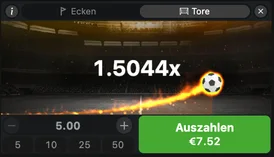
At 38:05 into the match, the multiplier stood at 1.5377x. By 38:40, thirty-five seconds later, it had climbed to 1.5602x. By 39:38, roughly a minute after that, it reached 1.5974x, and that's where the bet was cashed out, for a payout of €7.99 on the original €5 stake.
Screenshots of the same round also caught the cash-out button's state at each point, and that sequence is worth showing in full:
| Match Time | Multiplier | Payout on This €5 Stake | Cash-Out Button |
|---|---|---|---|
| Earlier in the round | 1.5044x | €7.52 | Green, available |
| Shortly after | 1.5236x | €7.62 | Orange, blocked |
| 38:05 | 1.5377x | €7.69 | Orange, blocked ("Gefahr" showing on screen) |
| 38:40 (+35s) | 1.5602x | €7.80 | Orange, blocked |
| 39:38 (+58s) | 1.5974x | €7.99 (cashed out here) | Orange, blocked ("Ecke" showing on screen, a corner had just been given) |
The button was already blocked before the earliest timestamped checkpoint at 38:05 and stayed blocked straight through to 39:38, a continuous window of well over ninety seconds across four consecutive checkpoints, with the multiplier climbing the entire time it was locked. That's a genuinely long stretch to sit through without the option to act, not the brief flicker the "temporarily" in this game's rules might suggest.
The 39:38 checkpoint carries a second detail worth pulling out on its own: the on-screen label at that instant was "Ecke", a corner. A corner is precisely the event that ends a Corners-trigger round. Because this stake's trigger was set to Goals, that corner passed the round by entirely, the multiplier kept climbing, and the cash-out happened a beat later at 1.5974x. Run the same moment with Corners as the trigger instead and the round would have ended right there, corner registered, stake settled, no multiplier walkthrough to write about.
Run the arithmetic across the full stretch and the pace comes out to roughly 0.04x per minute: from 38:05 to 39:38 is 93 seconds, and the multiplier gained 0.0597x in that window. Stretching that rate forward as pure arithmetic, not a prediction, reaching 2x from 1.5974x would take somewhere around nine more minutes at the same pace, if the pace held, which nothing about the mechanic guarantees. A dangerous attack, a corner won moments later, or simply a faster or slower stretch of play could change that estimate as soon as the next checkpoint.
A few things stand out from watching that sequence play out. First, the pace: over roughly ninety seconds of match time, the multiplier moved from about 1.54x to about 1.60x, a gain of just under 0.06x. That's a slow, steady climb, not the kind of rapid ramp you might expect from crash-game marketing clips elsewhere. If you're picturing a multiplier that doubles in a few seconds, this example says otherwise, at least for this round, this stake, and this trigger.
Second, the timing: this cash-out happened close to the 40-minute mark of the match, meaning the goal-trigger round had already survived most of the first half without a goal landing, which lines up with how relatively rare goals are compared to corners (more on that in the risk-profile section below).
It's worth being direct about what this example does and doesn't tell you. It's one observed round, not an average across hundreds of them, so treat "about 1.6x over roughly 40 minutes" as a real, specific data point rather than a guaranteed pace every round will follow. Multiplier growth on any individual round depends on how the match itself unfolds, how early or late the trigger event lands, and which trigger was picked. What this walkthrough does show honestly is that Betiator's multiplier growth, at least in this instance, was measured and gradual rather than explosive, and that a modest stake produced a modest, real payout rather than an inflated example built to look better than the mechanic actually performs. It could just as easily have ended at 39:39 with a goal and a lost stake; that's the trade-off built into the game, not a detail this guide can smooth over.
The Round Above, In Numbers
€5 in, 1.5974x at 39:38, €7.99 out, the exact walkthrough covered just now, not a tidied-up example. Every live match carrying the game runs on the same mechanic, and where to find one is covered further down this guide.
To the sportsbookBetiator vs Aviator: Key Differences
The most direct comparison for Betiator is Aviator, the crash-style aviator game from Spribe that popularized the "stake, watch a multiplier climb, cash out before it crashes" format across online casinos. They share a genre, not a mechanic.
Spribe Aviator runs on a provably-fair random number generator: the crash point for every round is generated algorithmically before the round starts, unconnected to anything happening anywhere else. Betiator's crash point, by contrast, is a live football event, a corner or a goal, depending on what was picked. That single difference drives most of the practical distinctions summarized in the table below.
The most consequential one for how a round actually plays: there's no equivalent to Betiator's danger-window cash-out block in the RNG version of this genre. Cash-out there is available at every point up until the multiplier crashes, full stop, with no in-between state where the mechanic itself takes control away from a player temporarily. Betiator's Gefahr/Sicher system has no counterpart in that format.
The other notable gap is what each game is tied to. The RNG version exists independent of any external event; it's a standalone game that opens regardless of what's on TV. Betiator can't be separated from a live match: no fixture in progress, real or simulated, means no round available. That also means Betiator inherits football's own rhythm, its lulls, its dangerous spells, its stoppage time, in a way a pure random-number game structurally can't. Neither format is "safer" in a risk sense; both carry the same basic possibility of losing a stake quickly, just through different mechanisms (an algorithm on one side, a live match event on the other).
| Attribute | Betiator | Aviator | Traditional Live Betting |
|---|---|---|---|
| Crash trigger | Real or simulated match event (corner/goal) | Random number generator | No crash mechanic |
| Player picks trigger type | Yes, corners or goals | No | Not applicable |
| Cash-out availability | Available except during danger windows | Available at any point before the crash | Depends on operator's cash-out offer |
| Cash-out can be blocked | Yes, during dangerous attacks and penalties | No | Not applicable |
| Bonus mechanic | Bonus boosts for surviving longer | Varies by operator promotion | Varies by operator promotion |
| Tied to a live match | Yes, always | No | Yes, always |
| Provider | Delasport | Spribe | Varies by odds supplier |
| Typical license | Follows the licensing operator (see Legitimacy section) | Follows the licensing operator | Follows the licensing operator |
| Available on SRL | Yes | No | Rarely |
| Mobile support | Yes, browser-based | Yes, browser-based | Yes, browser-based |
Betiator vs Traditional Live Betting
Traditional live betting and Betiator both let you react to a match in progress, but they settle completely differently: one waits for full time or a market-specific event, the other resolves the instant a specific trigger happens.
A standard in-play bet, backing a team to win, betting on total goals, taking a corner-count line, sits open until the match ends or the market itself settles (a total-goals bet settles once the number is mathematically decided, for instance). Odds move throughout, but a bettor isn't actively managing a live number the way you are in crash gambling; you place the bet and wait for the outcome, checking back in occasionally rather than watching a multiplier tick upward in real time.
Betiator compresses that waiting period into something far more active. Instead of one outcome decided at full time, each round is its own short-lived contract: it opens when you stake, and it closes the moment your chosen trigger event happens or you cash out first, whichever comes first. You're not predicting a final scoreline or an over/under threshold; you're managing a live position against a clock that has no fixed end and can close at any moment.
That difference changes what skill even means in each format. Traditional live betting rewards reading the match for signals about where the final outcome is heading: form, momentum, injuries, tactical changes. Betiator rewards reading the match for signals about timing and risk in the next few minutes: how likely a corner is right now, whether the match is entering a dangerous spell, whether it's worth holding through a danger window at all. Both are live betting in the broad sense, but they test different instincts, and neither one removes the basic risk that the match doesn't cooperate with the bet placed on it.
| Attribute | Betiator | Traditional Live Betting |
|---|---|---|
| Settlement trigger | Corner or goal, player's choice | Full-time result or market-specific event |
| Active multiplier to manage | Yes | No |
| Cash-out mid-bet | Yes, except during danger windows | Sometimes, if the operator offers cash-out on that market |
| Round length | Minutes, varies by trigger | Full match duration |
| Bonus mechanic | Bonus boosts for holding longer | Standard price boosts, operator-dependent |
| Requires constant attention | Mostly, while a round is live | Optional, can be set and checked later |
| Available on SRL | Yes | Depends on operator |
| Best suited for | A live, minute-to-minute decision | Setting a position and waiting |
Simulated Reality League: Betting Around the Clock
Simulated Reality League (SRL) is a continuously running set of simulated football matches, and Betiator supports it the same way it supports real fixtures: same triggers, same cash-out rules, same danger windows. Most operators file SRL under a separate virtual sports betting tab rather than mixing it into the real-match schedule, worth knowing since that tab is often the fastest route to an open Betiator round outside matchday hours.
Worth stating plainly, since it's not hidden anywhere else in this guide: every real number in this article, the multiplier walkthrough, the corner and goal counts used in the risk-profile sections, comes from an SRL fixture, not a real match. That's not a limitation of this guide, it's a fact about the only public data available right now, and it doubles as a useful illustration of what SRL actually looks like in practice.
How SRL Differs From a Real Match
Real football has natural dead time. Late at night, between fixture windows, during international breaks, there simply isn't a live match to open a Betiator round on. SRL fills that gap with matches running on a fixed schedule around the clock, generated by a simulation engine rather than played by human athletes, but structured with the same events, goals, corners, penalties, dangerous attacks, that a Betiator round depends on to function.
The mechanic itself doesn't change. A corner is a corner, a danger window is a danger window, whether the two teams on screen are Rayo Vallecano and Barcelona playing for real or their SRL counterparts. What can change is the shape of the match: a simulation engine isn't bound by human fatigue, weather, or a manager's substitutions, so the pacing of goals and corners across a simulated fixture won't necessarily mirror any specific real match. That's part of why the risk-profile numbers later in this guide are framed as general football math rather than SRL-specific statistics; the underlying event rate can vary between a real Tuesday-night fixture and a simulated one running at 3am.
Why SRL Is a Practical Way to Learn the Mechanic
Because SRL runs continuously rather than around a fixed kickoff time, it's the fastest way to watch several full Betiator rounds back to back, corners resolving, danger windows opening and closing, a goal-trigger round running its full length, without waiting on a real football calendar. That makes it a reasonable place to get a feel for how Corners and Goals actually behave differently, or to watch a Gefahr window play out from start to finish, before putting a stake on a real fixture where the same round only comes around when the schedule allows it.
Where to Play Betiator
Betiator is confirmed live on Slotimo, a sportsbook running on the Delasport platform. That's the only public, verifiable integration of the game at the time of writing, and this guide will be updated if that changes.
Delasport builds and licenses Betiator to sportsbook operators rather than running a consumer-facing site of its own, the same B2B model it uses for its wider live-betting and odds infrastructure. That structure means Betiator, in principle, isn't tied to a single brand, and broader rollout to other operators on the Delasport platform is a reasonable expectation as the product matures past its January 2026 public introduction at ICE Barcelona. That's not a confirmed fact for any specific operator today, though; it's an inference from how the licensing model works, not a claim about a specific site adding the game.
If you're trying to find Betiator on a site that offers it, look for it on the live match page of a football fixture, sitting alongside standard in-play markets, rather than in a dedicated casino or slots section. It's built into the match view itself, not filed under crash games or slots, which is also part of why it can be hard to find through search: the game lives inside sportsbook navigation rather than a separate lobby, and its availability depends on both the operator carrying it and a live match being on at the time. Getting from the live-betting section to the actual widget takes a specific click path, covered next.
Two Things Have to Line Up
Playing this live needs an operator that carries the game and a match actually running at the same time. Real fixtures come and go, but Simulated Reality League games run around the clock, which covers most of the gaps.
To the sportsbookHow to Find Betiator: A 5-Step Walkthrough
Knowing which sportsbook carries Betiator only gets you halfway there. The widget doesn't sit on the screen most people open first, and there's no menu entry anywhere that just says "Betiator", so the click path is worth spelling out in order rather than described in passing.
-
Open "LIVE BETTING." This is the section listing every match currently in progress, real or SRL, the same starting point you'd use for any other in-play bet on the site. A small BETi badge in a match row is the tell that Betiator is attached to that fixture, before you even open it.
The BETi badge marking a match with Betiator available in the live betting match list See it at the sportsbook -
Switch from "Overview" to "Event View." The default tab, "Overview", is a scoreboard-style list spanning every live sport and league at once, and Betiator's widget isn't on it at all, not tucked away, not collapsed, genuinely absent.
Overview tab open on the German-language build, live matches listed by league, no Betiator widget anywhere on the right See it at the sportsbook -
Pick the league from the picker on the left. "Event View" replaces the scoreboard list with a single selected match and the same league/match navigation used to open any live fixture.
Event View tab open, the league and match picker on the left, the Betiator widget rendered on the right with the green "Einsatz platzieren" button See it at the sportsbook -
Find and select the specific match. Choosing a different fixture from that same picker swaps the whole right-hand column to match it.
League and match picker on the left with a different fixture now selected, the Betiator widget on the right rebound to that match See it at the sportsbook -
Check the right-hand column. If Betiator is attached to that fixture, this is where it renders: the "Corners" and "Goals" trigger tabs, a stake amount, and the green "Place Bet" button, trigger picked and stake placed without ever leaving the screen, once there's a funded balance behind the stake.
Event View tab open on the English interface, the BETIATOR widget on the right with the green Place Bet €5.00 button See it at the sportsbook
That "if" in step 5 matters. The widget doesn't show up on every match, and it doesn't show up in every league. Worth saying plainly, because opening a match in "Event View" and finding no game panel there reads a lot like a broken page. It isn't; it's a fixture that simply doesn't carry Betiator, and checking a different match or league from the same picker is what actually tells you whether it's there.
From the point a round opens, the rest runs exactly as covered earlier in this guide: the multiplier climbs, the danger and safe states control when cash-out is available, and the round closes the moment the chosen trigger lands or the bettor cashes out first.
Cash-Out Strategy: Corner vs Goal Risk Profiles
Corner and goal triggers aren't just different in how a round feels, they carry genuinely different risk profiles once you factor in event frequency, round length, and how often cash-out actually gets blocked.
Start with the basic football math (general match statistics, not Betiator-specific data): a typical match produces roughly ten corners across both teams and closer to two or three goals in total. That gap alone explains most of the difference between the two triggers. Corners happen often enough that a corner-trigger round is statistically likely to end quickly; goals happen rarely enough that a goal-trigger round can run the length of a half or more before resolving, assuming it resolves on schedule at all.
In the interface, cash-out pays out the stake in full, there's no separate control for a partial cash out. That's worth knowing before sizing a stake: unlike some cash-out features attached to standard bets, there's nothing visible that lets you lock in part of a stake at one multiplier while leaving the rest running, so it's safer to plan around an all-or-nothing outcome on that specific round rather than a position you can trim as the multiplier climbs.
The math behind it is simple enough to do in your head, or with the cash out calculator further down this page: stake multiplied by the multiplier shown equals the payout if cashed out at that instant. The €5 example earlier in this guide cashed out at 1.5974x for €7.99, which is exactly that arithmetic (5 × 1.5974 ≈ 7.99). There's no fee or spread subtracted at cash-out time based on the game's public rules.
The table below lays out how the two triggers compare across the factors that actually affect strategy. Treat the frequency-based rows as estimates grounded in general football statistics and the mechanics of the game rather than measured Betiator data, since only one full round has been walked through and documented for this guide.
| Factor | Corner Trigger | Goal Trigger |
|---|---|---|
| Average event frequency per match | About 10 corners (both teams combined) | About 2 to 3 goals (both teams combined) |
| Typical round length | Short, often resolves within minutes | Longer, can run a half or more |
| Cash-out window frequency | Frequent, though rounds end quickly anyway | Frequent, with more time to use it |
| Danger-window frequency (estimate) | Lower; corners can arise outside sustained pressure | Higher; build-up to a goal often means sustained attacking pressure |
| Suggested bankroll approach | Smaller, more frequent stakes | Larger stakes reserved for rounds that can be watched through |
| Best suited for | Wanting quick resolution | Comfortable waiting through a longer stretch of play |
| Risk level | Lower variance per round, less time exposed | Higher variance, more time exposed to a blocked cash-out |
| Multiplier growth pace | Limited by short round length | More room to climb, though pace is gradual (see the walkthrough above) |
Is Betiator Legit? Licensing and Fairness
Betiator is legitimate in the sense that matters most for a real-money game: it's built by a licensed platform provider and distributed only through operators holding their own gambling licenses, not run by an anonymous or unregulated outfit.
Delasport, the company behind Betiator, operates as a licensed B2B betting-platform provider, and games built on that platform are distributed only through operators holding their own gambling licenses in the markets they serve. That's standard for how this kind of technology gets regulated: the license sits with the platform and the operator, not with each individual game as a separately certified product.
What's worth doing yourself before playing, rather than taking any single source's word for it, is checking the specific operator's own licensing. Most licensed sportsbooks list their regulator (which one depends on the market) in the site footer or on a dedicated "About us" or "Licensing" page, along with a license number you can look up directly with that regulator. If an operator offering Betiator doesn't show that information clearly, treat it as a reason for caution rather than assuming the game itself vouches for the site.
Fairness works differently here than in a standard RNG crash game, and that difference is really the core of the pitch. There's no algorithm to audit for randomness because there's no random number generating the crash point. The outcome is whatever happens in the match, verifiable by watching the same live coverage the game is built on top of. That also closes off a common search query for this genre: an "aviator predictor" tool, some app or formula claiming to forecast when a round will crash, has no equivalent that makes sense for Betiator. Nobody can predict when a corner or a penalty will occur any more precisely than by watching football normally. If a match looks like it's building toward a goal, that's visible to everyone watching, not a signal only some players get access to. It also cuts both ways: nobody can predict the opposite either, so there's no way to know a round is "due" to survive longer just because it has already run a while.
The honest caveat: because Betiator depends on a live match, the fairness question shifts from "is the algorithm random" to "is the underlying match legitimate," and for real fixtures that rests on the same trust framework as watching any football match or betting on any other live market. For SRL fixtures, the same logic applies to the simulation engine generating those matches rather than to Betiator's rules layer on top of it.
Mobile and Live Match Availability
Betiator runs in the browser on both desktop and mobile, built into the same live match page already being viewed on a phone, without a separate app to install.
On mobile, the layout compresses the same elements visible on desktop: the Corners/Goals tabs, the stake stepper and preset chips, the multiplier display, and the cash-out button, stacked to fit a smaller screen rather than hidden behind extra menus. The Gefahr/Sicher color states (orange for blocked, green for available) carry over identically, which matters more on mobile than desktop, since a bettor on a phone is less likely to be tracking the match on a second screen at the same time.
Availability follows the match schedule, not a fixed timetable. A round only exists while a football match, real or SRL, is actually live, so there's no way to open Betiator ahead of kickoff and wait inside it. Checking a live match page a few minutes before the scheduled start typically shows the game becoming available once the match itself goes live, and it disappears again once the match ends, the same as any other in-play market would. Because a round can only run while the match runs, there's also no way to leave a stake "open" overnight or step away mid-round; the trigger event doesn't wait for anyone to come back.
Betiator is currently available on Slotimo. 18+. Please gamble responsibly.